This article was first published in Le Devoir. It is reprinted here with the permission of its author, Rachad Antonius.
Translated from the original French
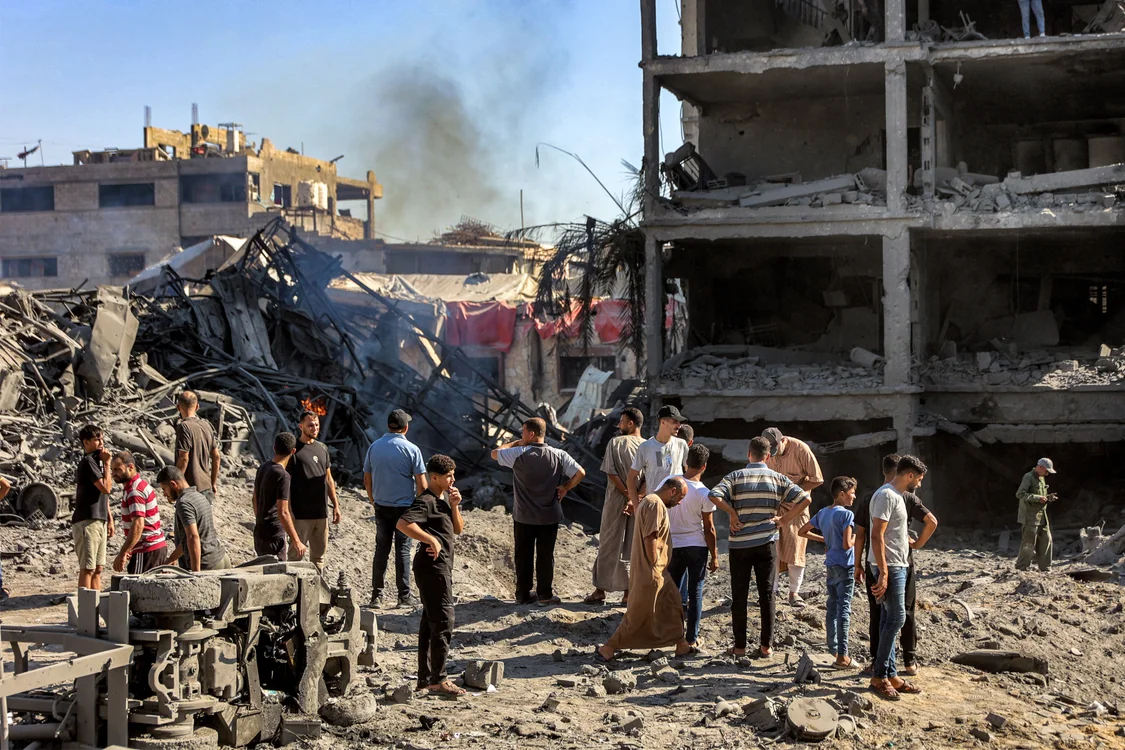
Words are insufficient to convey the horror unfolding in Gaza, the West Bank, and Lebanon, as well as the cynicism behind the violence perpetrated by the Israeli army and Jewish settlers in the West Bank. One can describe individual instances of this deadly madness: Palestinian families violently driven from their homes in the West Bank by Jewish settlers protected by the Israeli army, centuries-old olive trees uprooted or burned, and so on. The war against Gaza’s civilian population has produced the highest number of disabled children (maimed, deprived of their arms, and otherwise severely injured) among current conflicts, the highest number of orphans, the highest number of journalists killed, medical personnel killed, etc. Yet the overall representation of the war in Gaza continues to be shaped by the Israeli narrative.
This helps explain the indifference—or even the direct or indirect support—of political and media elites in Canada and Quebec toward the systematic destruction of life in the territories occupied by Israel. Three words seem essential to understanding this support: dehumanization, impunity, and disinformation. Three concepts linked together in a relentless and complementary logic.
Dehumanization
The process of dehumanization that enables this violence is twofold.
First, there is the dehumanization of Palestinian and Lebanese victims. This is evident in attacks on schools, places of worship, children, journalists, medical personnel, and in the famine caused by the blockade of food convoys, including powdered milk for children. It begins with rhetoric, when members of the Israeli government describe Palestinians as animals and justify their killing, but it is above all a deliberate and carefully planned strategy.
General Giora Eiland, who held some of the highest positions within Israel’s security establishment, provides one example among many. In an interview with the Israeli newspaper Yediot Aharonot, he stated: “The State of Israel therefore has no choice but to turn Gaza into a place where it is impossible to live… Creating a severe humanitarian crisis in Gaza is a necessary means of achieving this objective.” No effort has been spared in pursuing this goal.
But to reach that point, another form of dehumanization is necessary: the dehumanization of the aggressors themselves, who must disconnect entirely from their human reactions in order to carry out such a strategy. This becomes easier when the victims have already been dehumanized.
Some Israeli soldiers eventually come to realize what they are doing and transform their refusal into public opposition. Others do not necessarily develop a clear political understanding, and their distress in the face of the atrocities they commit manifests itself through psychological disorders or even suicide—both phenomena reportedly on the rise within the Israeli military. The growth of the anti-Zionist movement among Jews in Western countries should also be noted. At times, the excesses of Israeli policies become difficult to defend. Ehud Olmert, a former Prime Minister of Israel, and Tamir Pardo, former director of the Mossad, have publicly stated that they feel shame in response to the dehumanizing attacks carried out by settlers against Palestinian civilians.
Impunity
Impunity is what makes it possible to translate dehumanization into aggression against civilians, because such actions carry little cost for Israel. In the interview cited above, General Giora Eiland stated: “There is no reason to fear international pressure. Such pressure is actually beneficial and will allow us to ask in return: what exactly do you propose?”
Indeed, Israel acts with a sense of impunity, without fearing significant international consequences. Within Western governments there are members of parliament, diplomats, and senior officials who have become advocates for Israel. Any criticism of Israeli government policies is then immediately portrayed as a new form of antisemitism. This explains the confidence with which General Giora Eiland can assert that there is no need to fear international pressure.
Disinformation
The third factor that helps explain the posture of political elites toward Israel is disinformation, which in turn enables impunity. Disinformation is what allows the transition from dehumanization to impunity.
First, attacks against Palestinian civilians are presented—incorrectly—as a war against Hamas, which has been demonized and designated a “terrorist organization” by many Western governments, including Canada. For such representations to prevail, any information that contradicts them must be suppressed or portrayed as “controversial.” This occurs through the killing of journalists, who are the primary witnesses on the ground, and through direct pressure—often accompanied by accusations of antisemitism—against media outlets that report crimes committed by the Israeli army and West Bank settlers.
Second, the historical context is obscured. It is as though history began on October 7, 2023. Two central aspects of Israeli policy are largely omitted: the violent expulsion of Palestinian Arabs from their cities, villages, and homes since 1948, and the ongoing seizure of territory since that time, as well as the deadly violence inflicted on Palestinian civilians in the occupied territories since 1967. A third element consists of diverting attention away from realities on the ground and focusing instead on protest movements, which are presented exclusively as manifestations of antisemitism.
The final result is that major media outlets have largely adopted the Israeli narrative, even when they question certain details. One indication of this reality is that the title “Israel–Hamas War” appeared prominently for a long time in the background of television news studios, and reports from major media organizations about Gaza were likewise categorized under the heading Israel–Hamas War. The overall representation of the situation is thereby reversed: Israel is portrayed as the victim of aggressors surrounding it on all sides. The necessary and urgent policy shift begins with questioning this representation.
https://www.ledevoir.com/opinion/idees/994373/deshumanisation-impunite-desinformation
Rachad Antonius
The author is a sociologist and an associate professor in the Department of Sociology at UQAM (Université du Québec à Montréal).
Recent publication:
Rachad Antonius. La conquête de la Palestine, de Balfour à Gaza, une guerre de cent ans. Les Éditions Écosociété, 2024. (A digital version of the book is available)